What are marine fungi?
Marine fungi are any fungus that is recovered repeatedly from marine habitats because: 1) it is able to grow and/or sporulate (on substrata) in marine environments; 2) it forms symbiotic relationships with other marine organisms; or 3) it is shown to adapt and evolve at the genetic level or be metabolically active in marine environments (Pang et al. 2016).
It is important to distinguish marine fungi from ‘marine-derived fungi’ which are fungi that have been cultured from marine habitats, but may either be true marine fungi or fungi merely present as propagules or inactive mycelium.
Fungi grow in most marine habitats including deep sea sediments, hydrothermal vents, mangrove wood, driftwood, algae, mangrove leaves, palms, coral reefs, and salt marshes. They exist as endophytes, mycorrhizae, pathogens, parasites, and saprotrophs.
Fungi are essential in marine ecosystems for decomposing dead organic matter and as symbionts of many plants. However, most marine habitats have not been examined for fungi.
We have known about marine fungi for nearly two centuries. The first reports of marine fungi were from Montagne (1846), Cotton (1909) and Sutherland (1915). There are now more than 1800 species of marine fungi described (Calabon et al. 2023). However, as with most fungi, most species have not yet been described.
Marine fungi on wood
One way to see some marine fungi is to pick up a piece of decaying wood from a marine habitat. You can often see little black spots or bumps. These are often the reproductive structures of marine fungi. If you use a hand lens (10x or 20x) to examine the wood then you will see these structures more clearly. If you use a needle or fine tweezers to pick off the reproductive structures and put them onto a microscope slide (see how to examine marine and freshwater fungi [coming soon]) you will see a huge diversity of colours, shapes, and sizes of propagules and the structures that make the propagules. Most fungi on wood are ascomycetes either in their sexual or asexual state.
It is important to remember that these structures are just the reproductive parts of the fungus. The growing, vegetative stage is the hyphae (or mycelium) growing either on or inside the wood. These are usually not visible without a microscope. This the part of the fungus that is decomposing the wood. Fungi produce an array of enzymes which are specialised in breaking down large compounds such as ligno-cellulose.
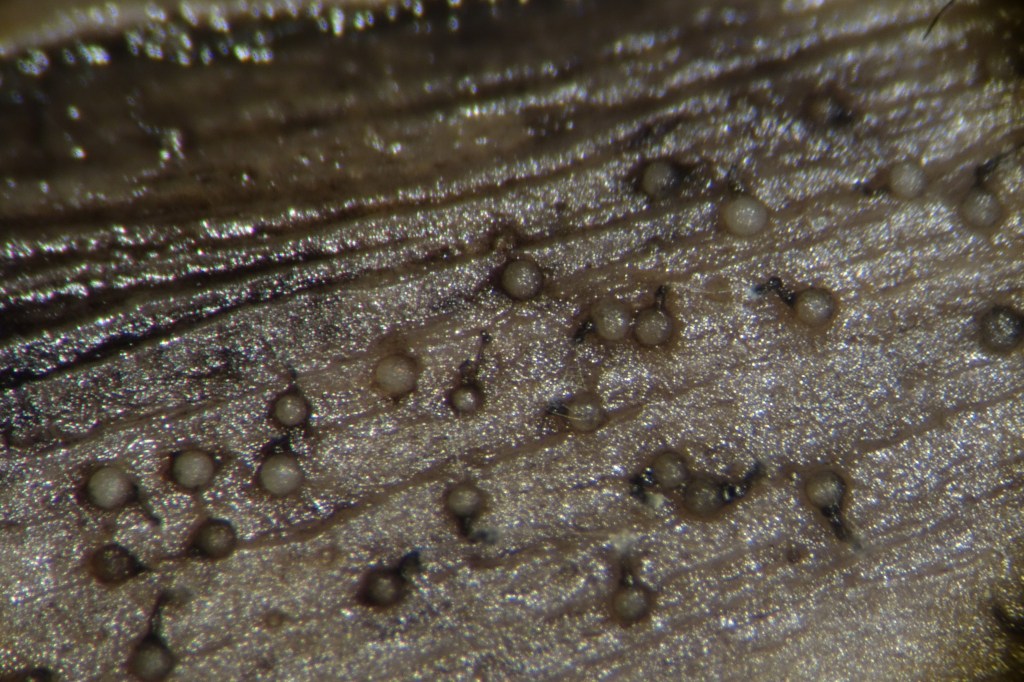
These are the sexual reproductive structures (ascomata) of Sammeyersia grandispora, a common and widespread marine ascomycete, under a dissecting microscope at 25x magnification:
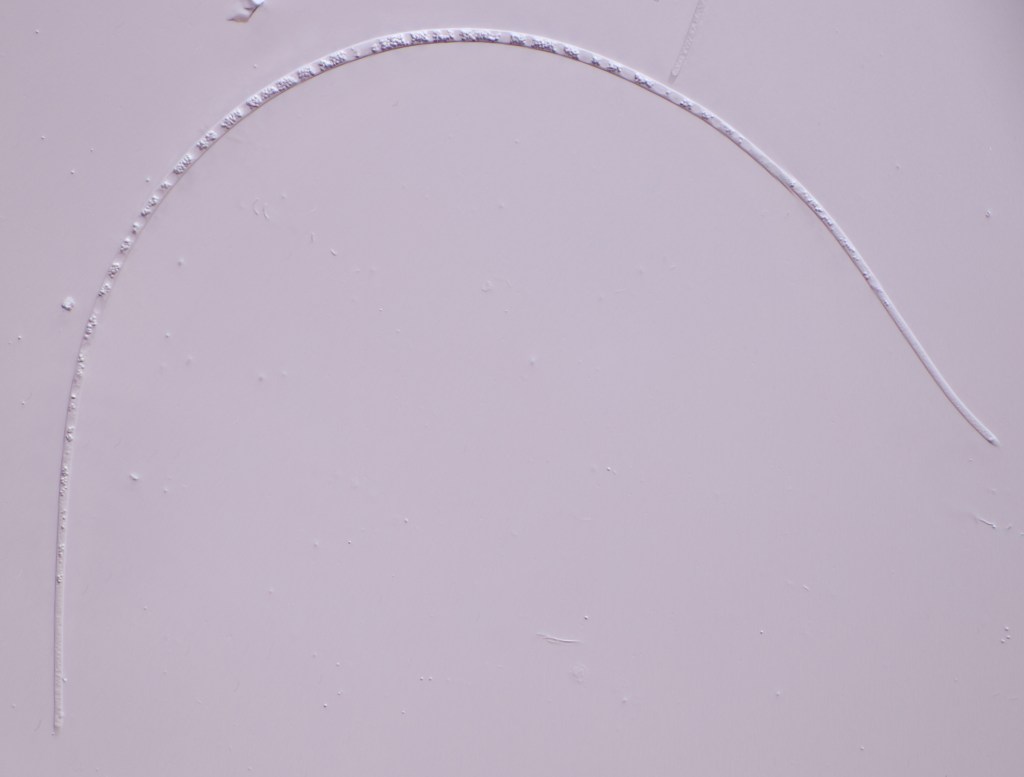
This is one of the ascospores inside the ascomata of Sammeyersia grandispora viewed under a compound microscope (400x):
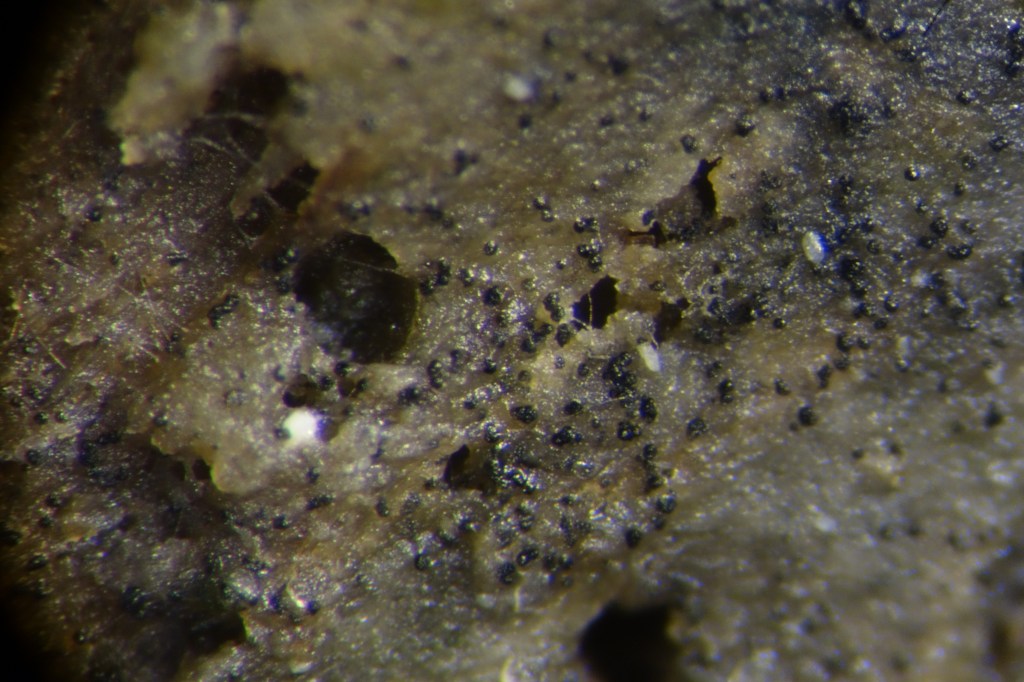
These small black bumps are the asexual reproductive structures (conidia) of Moromyces varius at 25x magnification.
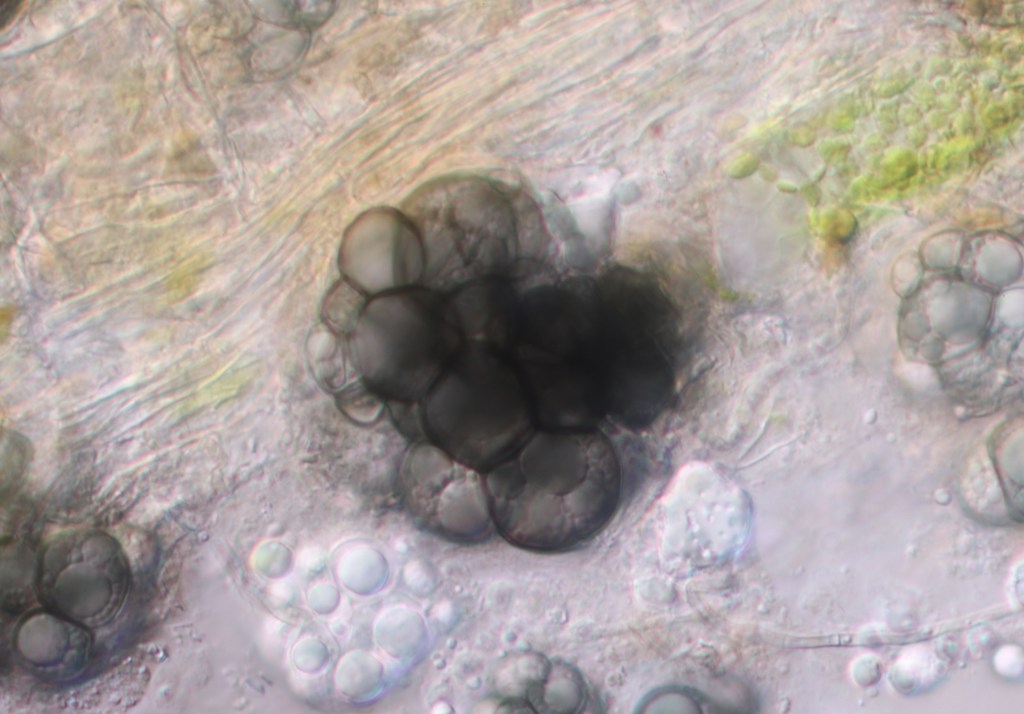
This is the same species under a compound microscope at 400x magnification:
References
Calabon MS, Jones EBG, Pang K-L, Abdel-Wahab MA, Jin J, Devadatha B, Sadaba RB, Apurillo CC, Hyde KD. 2023. Updates on the classification and numbers of marine fungi. Botanica Marina 66: 213–238.
Cotton, A.D. (1909). Notes on marine Pyrenomycetes. Trans. Br. Mycol. Soc. 31: 92–99.
Montagne, C. (1846). Flore d’Alg´erie. Classis I. Acotyledoneae Juss. OrdoI. Phyceae Fries. In: (J.B.G.M. Bory de Saint-Vincent JBGM, and M.C. Durieu De Maisonneuve, (Eds.). Exploration scientifique de l’Alg´erie pendant les ann´ees 1840, 1841, 1842. Sciences physiques. Botanique, Vol. 1, Imprimerie Royale, p. 197. Paris, plates 1–16.
Pang, K.L., Overy, D.P., Jones, E.B.G., Calado, M.L., Burgaud, G., Walker, A.K., Johnson, J.A., Kerr, R.G., Cha, H.-J., and Bills, G.F. (2016). ‘Marine fungi’ and ‘marine-derived fungi’ in natural product chemistry research: toward a new consensual definition. Fungal Biol. Rev. 30: 163–175.
Sutherland, G.K. (1915). New marine fungi on Pelvetia. New Phytol. 14: 33–42.
 Australian freshwater and marine fungi